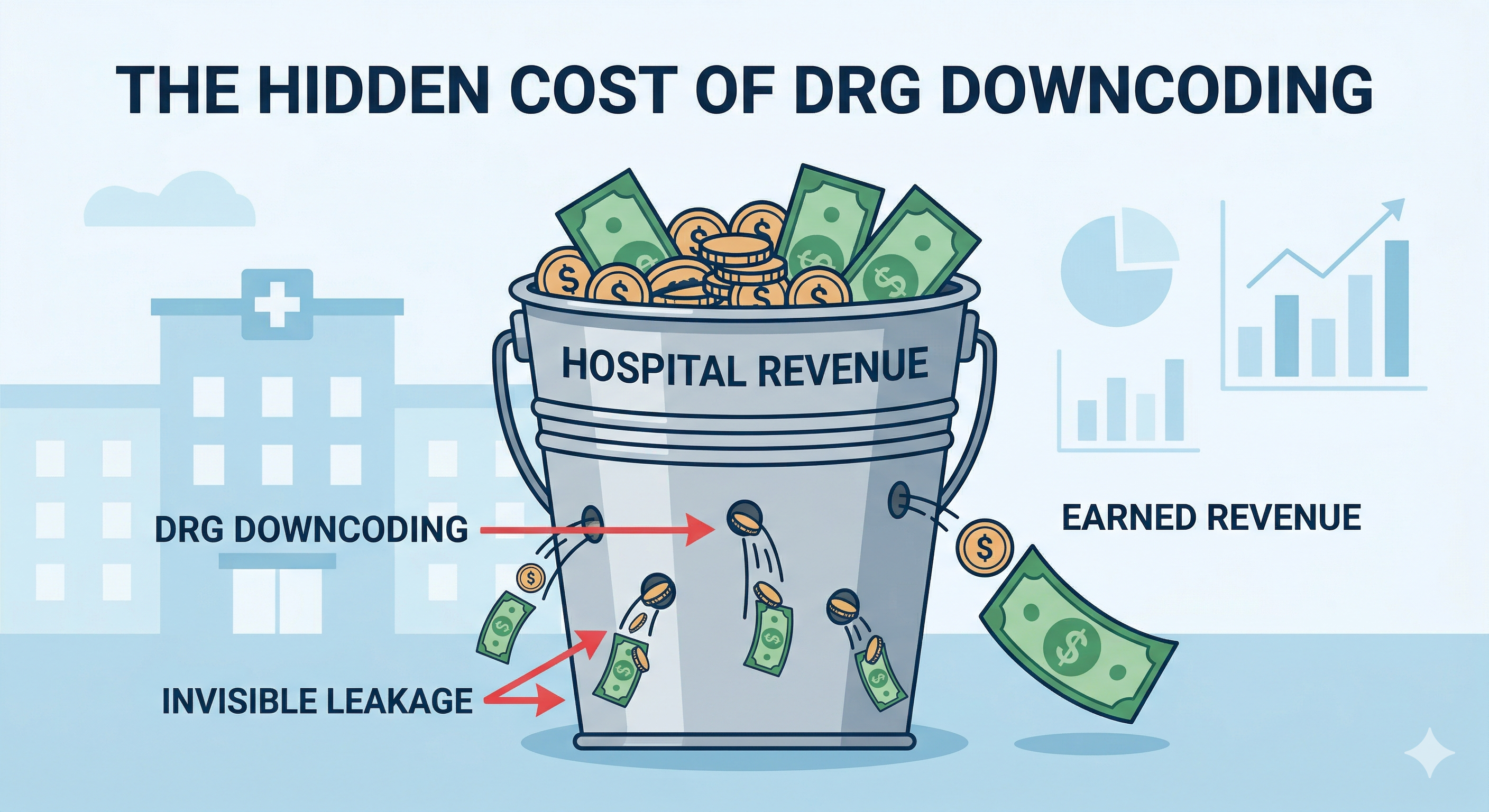
DRG downcoding is a major cause of revenue loss that often goes unnoticed. Unlike denied claims, which trigger alerts and require extra work, downcoded claims are simply paid at a lower rate. They move through the system quietly, costing hospitals millions of dollars for care that has already been provided. This article explains the financial impact of these errors and how to address them.
What is DRG Downcoding?
Downcoding happens when a hospital claim does not fully reflect how sick a patient really was. This results in a lower payment than the hospital deserves. It usually occurs because a doctor’s notes were not specific enough, or a coder chose a general code because they lacked detailed information. These claims are not fraudulent; they are just incomplete, meaning the hospital is leaving money on the table.
What the Data Shows
Most U.S. hospitals have coding accuracy rates between 85% and 92%. This means up to 15% of cases are coded at a lower level than the medical records would support. For a typical 200-bed hospital, this can result in over $6 million in lost revenue every year.
Most of this loss happens in a few specific areas:
Sepsis and organ failure
Heart failure details
Respiratory failure types
Malnutrition levels
Kidney injury staging
Specific types of encephalopathy
The Financial Impact
The difference between a basic code and a more specific one can be significant. In some cases, adjusting a single code to reflect the true complexity of a patient's condition can increase reimbursement by $7,000 or more per case. Since the medical care has already been delivered, this extra revenue has no added cost, making it highly valuable for a hospital's bottom line.
Why Denial Rates Don't Tell the Whole Story
Revenue teams often focus on denial rates because they are easy to track. However, downcoded claims are never denied; they are just underpaid. A hospital might have a very low denial rate while still losing millions of dollars because they are not looking at these invisible underpayments. A strong revenue program needs to look at both denials and coding accuracy.
How to Fix the Problem
To recover this revenue, leadership should follow a simple process. First, run a small audit of about 50 to 100 charts to see how often downcoding is happening. Second, use those results to estimate the total annual loss. Finally, look at the potential return on investment for better tools.
Modern platforms, such as the Prente Health calculator, help hospitals find these gaps by using technology to flag missing documentation in real time. This allows doctors to clarify their notes before the bill is even sent.